The Ecclesiastical Elevator
The following is the script for the video:
How did Jesus describe the Jewish religious leaders? In Matthew 23, The Message tells us—in today’s terms: “They love to sit at the head table at church dinners, basking in the most prominent positions, preening in the radiance of public flattery, receiving honorary degrees, and getting called ‘Doctor’ and ‘Reverend.’”
Then Jesus warns his disciples: “Don’t let people do that to you, put you on a pedestal like that.” Reaching the top of a pedestal means going up, up, and up. How? By getting lifted. Elevated. What provides the lift? An elevator created by the system of doing church we have all inherited. Let’s think of the various elevator stops as “floors.” We’ll look at six floors. All by itself, a given floor may not pose a problem. But taken together, the six floors can easily lead to unintended consequences.
What follows does not target any leader or any church. Rather, it asks us to look honestly at the system and its ecclesiastical elevator—inherited from centuries of tradition. This system lifts church leaders, especially pastors, onto that pedestal Jesus warns us about.
For many, EDUCATION opens the first-floor door of the ecclesiastical elevator. Theological schools offer a variety of advanced degrees, such as Master of Divinity, Master of Arts in Counseling, Master of Arts in Theology and Ministry, and Doctor of Divinity. Education is good—but it has no place in church life as an elevator that distances and separates people.
Floor two on the ecclesiastical elevator involves IDENTIFICATION. The clergy-laity distinction that began centuries ago never surfaced in the New Testament Church. This leads to a practice Jesus warned about—the use of religious titles, such as: Reverend, The Right Reverend.
Or take the term Pastor. Rather than being used as a mere role description, it gets capitalized and used as an elevating title. Notice the difference. Title: “Pastor Jones,” with a capital P. Role Description: “Mr. Jones, a pastor” lower case P. Each tells what Jones does. But “Pastor,” used as a title, elevates. And so the Pastor titles multiply: Senior Pastor, Associate Pastor, Assistant Pastor, Administrative Pastor, Worship Pastor, Youth Pastor, Children’s Pastor.
Next, the ecclesiastical elevator reaches Floor 3, FUNCTION. Here, only those with proper education and titles are seen as qualified to superintend certain functions within the church: They preach sermons, officiate at weddings, conduct baptismal events, oversee Communion, and preside over memorial services.
These functions bring the elevator effect into play, because only someone from the clergy is seen as qualified to take charge of each one. This sends the message of superior authority and expertise. Repeatedly officiating these functions can also foster a kind of celebrity status.
At floor 4, the elevator reaches POSITION, a raised stage. Like a pedestal, this platform places those on it in a higher position where they may be seen. Trophies get displayed on pedestals, so stages can make those on them seem like the prize people of the church. Often, spotlights from the ceiling focus attention on the speaker. Some churches dim the lights on the congregation, making the platform performers stand out even more.
In his third letter, John describes Diotrephes as “one who loves to be first.” He wanted recognition, status, and control. The desire for preeminence is built into our flesh, and a stage can whet that appetite. After sitting through a church meeting, a ten-year-old once said, “I want to be the speaker-man.” Stages originated in early Greek theaters. They are never seen in regular New Testament church gatherings.
Floor 5 opens out into the AMPLIFICATION room with its soundboards, microphones, and speaker system. Using these devices, an unseen technician amplifies the voice of the speaker, making it many times louder than that of all others in the room. The lack of microphones for everyone else effectively silences them. They remain voiceless as the meeting proceeds.
This arrangement stands in sharp contrast to what Paul calls for in I Cor. 14:26 and 31. “When you come together, each one has a hymn, a lesson, a revelation, a tongue, or an interpretation. . . . you can all prophesy one by one, so that all may learn and all be encouraged.”
Floor Six brings us to ACCLAMATION, public approval and praise. All members of Christ’s body need to hear encouragement from other members. But floor six is all about lavishing excessive applause on just one member of the body—the pastor. In 1992, the second Sunday in October was declared to be Pastor-Appreciation Day.
In the same year, the American Christian Honor Society set aside the second week in October as Pastor-Appreciation Week. Church people are encouraged to observe this week by scheduling special services, giving gifts to the pastor, and sending personal notes of gratitude.
Also in 1992, the American Christian Association established the entire month of October as Pastor-Appreciation Month. Yes, it’s true that Scripture urges that we give double honor those elders (plural) who teach the Word. But Scripture also tells us to honor one another. In each case, the Greek term translated “honor” is the same word. But might devoting an official day, week, and month to honor just one individual in a congregation contribute to the elevator effect?
Working together, the six floors of the elevator can weaken the body of Christ. By themselves, some elements that make up the ecclesiastical elevator can play helpful roles. EDUCATION, for example, gives us biblical scholarship—which the Church needs. Raised stages and sound systems are useful for those times when large groups assemble to hear special speakers. But regular church gatherings, need to protect the opportunity for “each one” to speak.
The man-made elevator system we have inherited comes with some seriously harmful side effects. First, it expects too much from just one member of the body. Pastor burnout is a phrase that has become all too well known. The New Testament church distributed local church leadership among a plurality of elders.
Second, at the same time, this man-made elevator expects too little from other members of the body. They easily think of themselves as not essential for any real body-building work. If the super-pastor can do everything, then the rest can sit back and watch the show. Body-building gifts go unused and so atrophy.
Third, it places a tripping hazard, a major temptation, in the path of that overloaded leader. All of us deal with the temptation to think more highly of ourselves than we should. Elevating one person so high and so often intensifies that temptation toward selfish ambition that Scripture warns s strongly against.
In reality, in Christ, God has already elevated all of us to the highest place. “And God raised us up with Christ and seated us with him in the heavenly realms in Christ Jesus.” That’s why Jesus expects each of us—from this place of God’s elevation—to do our share in the building up of his church. It “grows and builds itself up in love,” Paul says, “as each part does its work.”
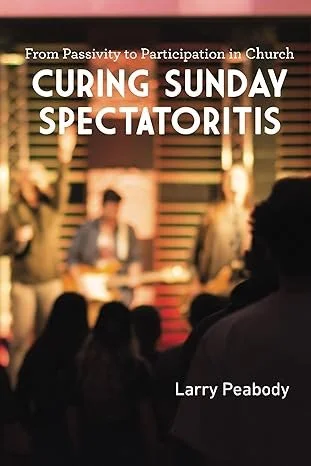
Page 61:
“But too often in a typically structured church gathering, the pastor does nearly everything: welcoming, preaching, praying, making announcements, offering the benediction, baptizing, and officiating at the Communion table. A pastor has the most access to and time with the microphone. Accepted church architecture puts the stage and pulpit—and thus the preacher—front and center. “